
纤维素酶检测试剂盒(CellG3方法),K-CELLG3

-
- 产地爱尔兰
- 品牌Megazyme
- 货号K-CELLG3
- 规格180次
详细描述
纤维素酶检测试剂盒(CellG3方法),K-CELLG3
介绍:
用于测量内切纤维素酶(内切 -1,4 -β-葡聚糖酶)的CellG3分析试剂 包含两个成分:
1)4,6- O-亚苄基-2-氯-4-硝基苯基-β-D-纤维二糖苷(BCNPG3)和2)热稳定的β-葡萄糖苷酶。亚苄基保护基团可防止β-葡萄糖苷酶对BCNPG3的任何水解作用。与内切纤维素酶一起孵育 会生成非封闭的比色寡糖,该寡糖会被辅助β-葡萄糖苷酶快速水解。因此2-氯-4-硝基苯酚的形成速率直接与内切纤维素酶水解BCNPG3 有关。加入Tris缓冲溶液(pH 9.0)后,反应终止,酚盐显色。
请注意,现在可以使用新的测定试剂盒 (K-CellG5)来测定 内切纤维素酶。 CellG5试剂含有一个纤维戊糖核心,对某些纤维素酶的敏感性大大提高。此外,CellG3中的亚苄基保护基团换成CellG5中的3-酮丁烯基可以显着提高底物的水溶性,从而降低了测定所需的DMSO浓度。由于已知DMSO会抑制某些纤维素酶,因此这是使用CellG5的另一个好处。Megazyme现在建议将 K-CellG5 用于所有内切纤维素酶的检测方法 。
纤维素酶检测试剂盒(CellG3方法),K-CELLG3
原理:
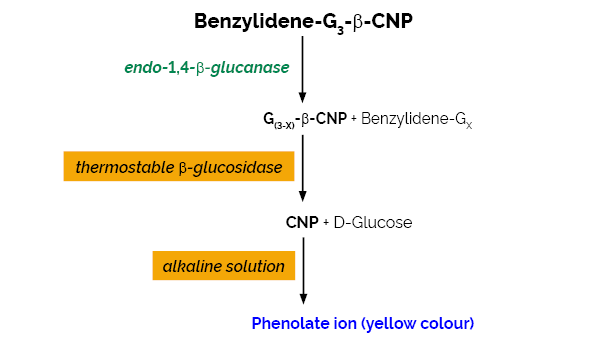
纤维素酶检测试剂盒(CellG3方法),K-CELLG3
特性
试剂盒规格: 180次
方法: 400 nm分光光度
总检测时间: 约20分钟
检测限: 0.05 U /毫升
稳定性: >2年
应用实例: 发酵液,工业酶制剂和生物燃料的研究
方法认证: 新颖的方法。注意:相似的荧光试剂(R-CELLFLR)的灵敏度也提高了10倍
优势: 成本低,操作简单,试剂稳定
包含标准品及高纯度酶
制备后所有试剂均稳定> 12个月
纤维素酶检测试剂盒(CellG5方法),K-CellG5-2V /4V
纤维素酶检测试剂盒(CellG5方法),K-CellG5-2V /4V
-
- 产地爱尔兰
- 品牌Megazyme
- 货号K-CellG5-2V
- 规格60次或120次/盒
详细描述

爱尔兰Megazyme纤维素酶检测试剂盒(CellG5方法),K-CellG5-2V /4V
品牌:Megazyme
规格:60次或120次/盒
试剂盒简介
爱尔兰Megazyme纤维素酶检测试剂盒(CellG5方法),K-CellG5-2V /4V,用于测量内切纤维素酶(内切-1,4 -β-葡聚糖酶)的CellG5分析试剂 包含两个成分:
1)4,6- O- (3-酮丁烯)-4-硝基苯基-β-D-cellopentaoside(BPNPG5)和2)热稳定的β-葡萄糖苷酶。酮保护基团可防止β-葡萄糖苷酶对BPNPG5的任何水解作用。与内切纤维素酶一起孵育 会生成非封闭的比色寡糖,该寡糖会被辅助β-葡萄糖苷酶快速水解。因此4-硝基苯酚的形成速率与内切纤维素酶水解BPNPG5直接相关 。加入Tris缓冲溶液(pH 9.0)后,反应终止,酚盐显色。
CellG5分析法代表了纤维素酶测量方法学的一大进步,该方法传统上依赖于底物,例如CM-纤维素,Avicel,纤维寡糖,滤纸或染色的多糖,包括CMC刚果红或纤维素天蓝色。
爱尔兰Megazyme纤维素酶检测试剂盒(CellG5方法),K-CellG5-2V /4V
检测原理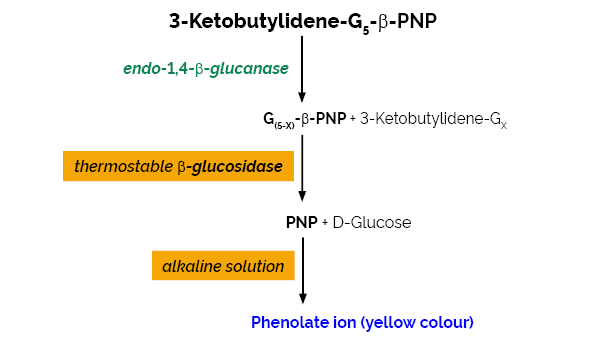
| 内容: | (K-CellG5-2V)60/120 测定法(手动)/ 240测定法(自动分析仪)或 (K-CellG5-4V)120/240 测定法(手动)/ 480测定法(自动分析仪) |
| 运输温度: | 常温 |
| 贮存温度: | 短期稳定性:2-8 ℃, 长期稳定性:参见各个组件标签 |
| 稳定性: | 在推荐的存储条件下> 2年 |
| 分析物: | 内切纤维素酶 |
| 分析形式: | 分光光度计,自动分析仪 |
| 检测方法: | 吸光度 |
| 波长(nm): | 400 |
| 信号响应: | 增加 |
| 检测限: | 1.2 x 10 -3 U /毫升 |
| 总测定时间: | 10分钟 |
| 应用实例: | 发酵液,工业酶制剂和生物燃料的研究。 |
| 方法识别: | 新颖的方法 |
优点
-
非常划算
-
所有试剂均稳定> 4年
-
完全特异于纤维素酶
-
一般适用且高度敏感
-
格式简单,非常适合自动化
-
含标准品
试剂盒组成
内切纤维素酶检测试剂盒[CELLG3方法] Cellulase Assay Kit (CELLG3 Method) 货号:K-CELLG3 Megazyme试剂盒
- 内切纤维素酶检测试剂盒[CELLG3方法]
-
英文名:Cellulase Assay Kit (CELLG3 Method)
-
货号:K-CELLG3
-
规格:180 / 360 assays per kit / 720 (auto-analyser)
市场价: 6000元
纤维素酶是一种重要的酶产品,是一种复合酶,主要由外切β-葡聚糖酶、内切β-葡聚糖酶和β-葡萄糖苷酶等组成,还有很高活力的木聚糖酶。
提供内切纤维素酶检测试剂盒,色度法(400 nm)测定酶制品和发酵产品中的纤维素酶(内切-1,4-β-葡聚糖酶)。
内切纤维素酶检测试剂盒(CELLG3方法) K-CELLG3
使用高纯度β-葡萄糖苷酶和苯亚甲基阻断,2 – 氯-4 – 硝基苯基-β-Dcellotrioside(BClPNPβ-G3)。 β-葡萄糖苷酶的能力确保测定的可靠的最大的灵敏度。BClPNPβ-G3的水解为苯亚甲基,通过纤维素酶阻断纤维二糖和2-氯-4 -硝基苯基-β-D-葡萄糖, 2-Cl-4-硝基苯基-β-D-葡萄糖通过β-葡萄糖苷酶立即裂解为D-葡萄糖和游离的2 – 氯-4 – 硝基苯酚(ClPNP)。
反应时间:16min
适用样品:酶制品和发酵产品
优点:
价格低廉(每次检测成本)
特异性高
方法简单
包含标准品
The CELLG3 assay reagent for the measurement of endo-cellulase (endo-1,4-β-glucanase) contains two components;
Colourimetric method for the determination of
endo-1,4-β-glucanase (cellulase) in enzyme preparations and fermentationproducts
Principle:
(endo-1,4-β-glucanase)
(1) 3-Ketobutylidene-G5-β-PNP + H2O → Blocked-GX + G(5-X)-β-PNP
(thermostable β-glucosidase)
(2) G(5-X)-β-PNP + H2O → D-glucose + PNP
(alkaline solution)
(3) PNP → phenolate ion (yellow colour)
Note: PNP = 4-nitrophenol
Kit size:
K-CELLG5-4V                  120 / 240 assays (manual) / 480 (auto-analyser)
                                         or
K-CELLG5-2V                   60 / 120 assays (manual) / 240 (auto-analyser)Method:                           Spectrophotometric at 400 nm
Total assay time:             10 min
Detection limit:                3.5 x 10⁻⁴ U/mL
Application examples:
Fermentation broths, industrial enzyme preparations, biofuels research
Method recognition:        Novel method
暂无问题解答
暂无视频
内切纤维素酶检测试剂盒[CELLG5方法] Cellulase Assay Kit (CELLG5 Method) 货号:K-CELLG5-2V Megazyme试剂盒
- 内切纤维素酶检测试剂盒[CELLG5方法]
-
英文名:Cellulase Assay Kit (CELLG5 Method)
-
货号:K-CELLG5-2V
-
规格:60 / 120 assays (manual) / 240 (auto-analyser)
- Very cost effective
- All reagents stable for > 4 years
- Completely specific for cellulase (endo-1,4-glucanase)
- Generally applicable and highly sensitive
- Simple format. Well suited to automation
- Standard included
市场价: 3800元
The CELLG5 assay reagent for the measurement of
endo-cellulase (endo-1,4-β-glucanase) contains two components;
1) 4,6-O-(3-Ketobutylidene)-4-nitrophenyl-β-D-cellopentaoside (BPNPG5) and 2) thermostable β-glucosidase. The ketone blocking group prevents any hydrolytic action by the
β-glucosidase on BPNPG5. Incubation with an endo-cellulase generates a non-blocked colourimetric oligosaccharide that is rapidly hydrolysed by the ancillary β-glucosidase. The rate of formation of 4-nitrophenol is therefore directly related to the hydrolysis of BPNPG5 by the endo-cellulase. The reaction is terminated and the phenolate colour is developed on addition of Tris buffer solution (pH 9.0).
Colourimetric method for the determination of
endo-1,4-β-glucanase (cellulase) in enzyme preparations and fermentation products
Principle:
(endo-1,4-β-glucanase)
(1) 3-Ketobutylidene-G5-β-PNP + H2O → Blocked-GX + G(5-X)-β-PNP
(thermostable β-glucosidase)
(2) G(5-X)-β-PNP + H2O → D-glucose + PNP
(alkaline solution)
(3) PNP → phenolate ion (yellow colour)
Note: PNP = 4-nitrophenol
Kit size:
K-CELLG5-4V                  120 / 240 assays (manual) / 480 (auto-analyser)
                                       or
K-CELLG5-2V                   60 / 120 assays (manual) / 240 (auto-analyser)Method:                           Spectrophotometric at 400 nm
Total assay time:             10 min
Detection limit:                3.5 x 10⁻⁴ U/mL
Application examples:
Fermentation broths, industrial enzyme preparations, biofuels research
Method recognition:         Novel method
Advantages
暂无问题解答
暂无视频
内切纤维素酶检测试剂盒[CELLG5方法] Cellulase Assay Kit (CELLG5 Method) 货号:K-CELLG5-4V Megazyme试剂盒
- 内切纤维素酶检测试剂盒[CELLG5方法]
-
英文名:Cellulase Assay Kit (CELLG5 Method)
-
货号:K-CELLG5-4V
-
规格:120 / 240 assays (manual) / 480 (auto-analyser)
- Very cost effective
- All reagents stable for > 4 years
- Completely specific for cellulase (endo-1,4-glucanase)
- Generally applicable and highly sensitive
- Simple format. Well suited to automation
- Standard included
市场价: 6042元
The CELLG5 assay reagent for the measurement of
endo-cellulase (endo-1,4-β-glucanase) contains two components;
1) 4,6-O-(3-Ketobutylidene)-4-nitrophenyl-β-D-cellopentaoside (BPNPG5) and 2) thermostable β-glucosidase. The ketone blocking group prevents any hydrolytic action by the
β-glucosidase on BPNPG5. Incubation with an endo-cellulase generates a non-blocked colourimetric oligosaccharide that is rapidly hydrolysed by the ancillary β-glucosidase. The rate of formation of 4-nitrophenol is therefore directly related to the hydrolysis of BPNPG5 by the endo-cellulase. The reaction is terminated and the phenolate colour is developed on addition of Tris buffer solution (pH 9.0).
Colourimetric method for the determination of
endo-1,4-β-glucanase (cellulase) in enzyme preparations and fermentation products
Principle:
(endo-1,4-β-glucanase)
(1) 3-Ketobutylidene-G5-β-PNP + H2O → Blocked-GX + G(5-X)-β-PNP
(thermostable β-glucosidase)
(2) G(5-X)-β-PNP + H2O → D-glucose + PNP
(alkaline solution)
(3) PNP → phenolate ion (yellow colour)
Note: PNP = 4-nitrophenol
Kit size:
K-CELLG5-4V                  120 / 240 assays (manual) / 480 (auto-analyser)
                                       or
K-CELLG5-2V                   60 / 120 assays (manual) / 240 (auto-analyser)Method:                           Spectrophotometric at 400 nm
Total assay time:             10 min
Detection limit:                3.5 x 10⁻⁴ U/mL
Application examples:
Fermentation broths, industrial enzyme preparations, biofuels research
Method recognition:         Novel method
Advantages
暂无问题解答
暂无视频
纤维素酶(CELLG5 Method)
纤维素酶(CELLG5 Method)

-
- 产地爱尔兰
- 品牌Megazyme
- 货号K-CELLG5-4V
- 规格120 / 240 assays (manual) / 480 (auto-analyser)
纤维素酶(CELLG5 Method)
纤维素酶(CELLG5 Method)

-
- 产地爱尔兰
- 品牌Megazyme
- 货号K-CELLG5-2V
- 规格60 / 120 assays (manual) / 240 (auto-analyser)
详细描述
(CELLG5 Method)
The CELLG5 assay reagent for the measurement of
endo-cellulase (endo-1,4-β-glucanase) contains two components;
1) 4,6-O-(3-Ketobutylidene)-4-nitrophenyl-β-D-cellopentaoside (BPNPG5) and 2) thermostable β-glucosidase. The ketone blocking group prevents any hydrolytic action by the
β-glucosidase on BPNPG5. Incubation with an endo-cellulase generates a non-blocked colourimetric oligosaccharide that is rapidly hydrolysed by the ancillary β-glucosidase. The rate of formation of 4-nitrophenol is therefore directly related to the hydrolysis of BPNPG5 by the endo-cellulase. The reaction is terminated and the phenolate colour is developed on addition of Tris buffer solution (pH 9.0).
The CELLG5 assay represents a huge step forward in the methodology for the measurement of cellulase that traditionally relied on substrates such as CM-cellulose, Avicel, cellooligosaccharides, filter paper or dyed polysaccharides including CMC Congo red or cellulose azure.